

Agent Discovery Files and llms.txt describe a practical setup of AI Discovery Files: llms.txt can provide language models with guidance on important website content, while ADF, as a Berger+Team architectural approach, bundles machine-readable identity, brand information, FAQs, copyright notices, knowledge catalog, and API endpoints.
It's important to understand the context: llms.txt is currently a convention or proposal, not an official standard like a ratified W3C or IETF standard. This file doesn't replace SEO, structured data on your website , or a clean information architecture. According to Jeremy Howard's llms.txt proposal page, it's a suggested Markdown file that provides LLM-friendly information. You can find the source at the end of this article.
Discovery files are not a control mechanism for AI responses. They can provide guidance, improve machine interpretability, and make governance transparent. However, discovery files do not guarantee citation in ChatGPT, Google AI Overviews, or other AI responses.
I'm writing this guide based on my practical experience working with SMEs in Bolzano, South Tyrol, and the DACH region (Germany, Austria, Switzerland). In over 20 years of branding, web development, and digital strategy, I've learned that small businesses don't need added technical complexity. They need an easy-to-understand system that clearly explains their brand, services, locations, contact options, and rights—for people, search engines, and increasingly, AI agents.
Agent Discovery Files and llms.txt: What Discovery Files Do
llms.txt is a text file in the root directory of a website, usually under /llms.txtThe file can curate important pages, documentation, service areas, or FAQs in such a way that language models and tools can more quickly access the website structure. The goal is orientation, not control.
Agent Discovery Files , or ADF for short , are not a generally accepted industry standard for us. ADF is a Berger+Team architectural approach : a set of machine-readable files and interfaces that gives a website a clearer, machine-readable identity. I use ADF as an architectural pattern, not as a standard.
An ADF setup can, for example, contain the following components:
- Identity files: Company name, location, legal form, contact person, languages, region and service areas.
- Brand files: Positioning, tone of voice, values, target groups, exclusions and communication rules.
- FAQ files: Frequently asked questions with clear answers that are internally consistent with the website.
- Rights and usage files: Instructions on how content should be used, quoted, or not used.
- API endpoints: Structured access to services, contact information, FAQs, references, or a knowledge catalog.
The difference to a traditional website is simple: A website is primarily designed for browsers and humans. Discovery files add a machine-readable layer to the website. This layer can help AI agents more quickly understand who you are, what you offer, which content is important, and which rules apply.
AI Web Architecture: robots.txt, Schema.org, Google Extended and ADF
In discussions with clients, I often notice that various technical files are lumped together. This is precisely where false expectations arise. Therefore, clear differentiation is crucial.
- robots.txt: robots.txt is part of the Robots Exclusion Protocol. RFC 9309 describes how services can store rules in a file called robots.txt.
/robots.txtprovide information that crawlers should consider when accessing URI paths. - Schema.org: Structured data Schema.org describes content in a semantically machine-readable way, for example, companies, people, products, services, articles, or FAQs. Schema.org describes itself as a collaborative community activity for structured data on the web.
- Google Extended: According to Google, Google Extended is a standalone product token for robots.txt. Website operators can use it to control certain uses by Gemini Apps, Vertex AI API for Gemini, and Grounding without automatically blocking Google Search altogether.
- llms.txt: llms.txt can provide a prioritized, LLM-friendly overview of important content. However, llms.txt is currently a proposal or an open convention.
- ADF: Berger+Team's Agent Discovery Files combine identity, brand, FAQ, rights, knowledge catalog and API endpoints into an architectural pattern for AI agents.
robots.txt provides crawler instructions. Schema.org describes entities and content. Google Extended pertains to specific Google AI uses. llms.txt curates content for LLM contexts. Agent Discovery Files bundle business identity and agent access.
What Discovery files must not promise
I'm not a fan of pushing SMEs into new technologies with unrealistic promises. An llms.txt file or an ADF set can't automatically turn your website into AI-generated responses. Discovery files don't prevent hallucinations either. Discovery files don't replace substantive expertise, clear positioning, or technical quality.
According to Google Search Central, for Google Search, AI Overviews and AI Mode can display relevant links, but Google does not specify any additional requirements for participation beyond basic search best practices. Therefore, technical discovery files can be helpful, but they cannot guarantee that individual websites will be cited.
What discovery files can do is more concrete and yet still valuable:
- Orientation: Important content is explicitly named instead of being hidden in the page noise.
- Consistency: Company data, services, and brand terms are maintained in a machine-readable location.
- Governance: Rights, contact methods and rules regarding updates are documented.
- Reusability: The same data can supply the website, app, shop, AI agents and internal systems.
- Less data chaos: Teams are working with a clearer source of truth instead of scattered PDFs, old texts, and conflicting information.
The Berger+Team architectural approach: ADF as a machine-readable identity
At Berger+Team in Bolzano, we don't think of website, branding, marketing, and AI separately. For me, a website isn't a digital brochure. A good website is a structured operating system for company knowledge.
ADF builds on precisely this. The approach doesn't start with technology, but with identity: Who are you? Who do you work for? What problems do you solve? What services do you offer? What can be said about your brand? Which statements would be false or misleading?
If these questions remain unanswered, even the best file won't help. AI will then quickly reveal that the foundation is unclear. That's why we almost always combine agent discovery files with branding, information architecture, and technical implementation. If you want to build this foundation properly, our website strategy and web development provide the practical framework for it.
A sensible ADF minimum for SMEs
An owner-managed company doesn't immediately need a complex agent platform. For many SMEs, a streamlined minimum is sufficient to start with.
- llms.txt: Curated overview of the most important content, services, guides and contact points.
- identity.json: Machine-readable identity including name, location, region, language, industry and contact information.
- brand.txt: Positioning, tone, values, and clear exclusions.
- faq-ai.txt: Key questions and answers in precise, quotable language.
- ai.txt: Information on content rights, citation, usage and contact for licensing questions.
API endpoints and an expanded knowledge catalog only become particularly relevant when a company has multiple systems, a lot of content, multiple languages, or automated processes.
SME Quick Check: Are you ready for llms.txt and ADF?
Before you create any files, check your foundation. This quick check prevents unnecessary technical work without strategic benefit:
- Page structure: Are there dedicated pages for services, target groups, FAQs, about us, and contact information?
- Performance: Are your offers clearly named and formulated the same way on all pages?
- NAP data: Are the name, address, and phone number consistent, especially for local businesses in South Tyrol?
- FAQ: Does your website answer real questions that potential customers ask before making an inquiry?
- Schema.org: Does your website use structured data for organization, local business, articles, services, or FAQs?
- Content rights: Is it clear which content should be quoted, adopted, or not used for AI purposes?
- Topicality: Have old services, prices, team data and contact methods been cleaned up?
- Internal linking: Are the service pages, guides, FAQs and contact information logically linked?
- Multilingualism: Are German, Italian, and, if applicable, English clearly separated and not mixed up?
- Contact points: Are there clear transitions from information to inquiry, telephone, email, or form?
If you're unsure about more than three points, I would first clarify the website architecture. A good starting point is our article on AI-ready websites as a foundation for SMEs , because it explains the basic logic behind btlabs Core.
Agent Discovery Files in practice: How we implement ADF at berger.team
Our own setup on berger.team is not a universally applicable model. It's an implementation example from our work. We use it to test how website content, brand identity, discovery files, and API endpoints can interact.
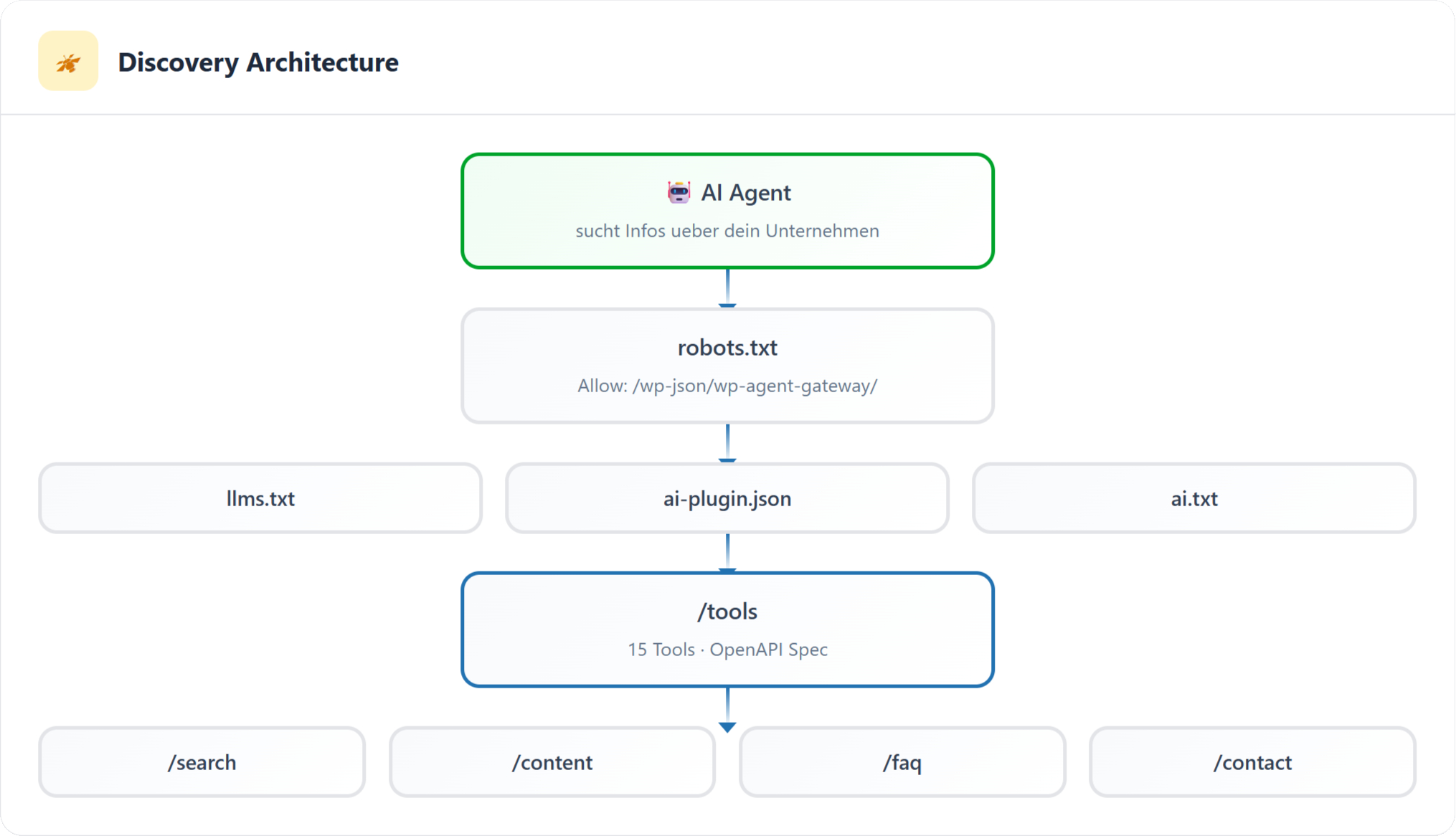
The basis consists of files such as /llms.txt, /llms-full.txt, /robots.txt, /robots-ai.txt, /ai.txt, /ai.json, /.well-known/ai-plugin.json, /brand.txt, /faq-ai.txt, /developer-ai.txt and /.well-known/security.txtIn addition, structured interfaces are provided via an agent gateway. These API endpoints make selected information such as company profile, services, FAQs, contact details, search functionality, and content available in a machine-readable format.
The key is not the number of files. The key is the distribution of roles:
- llms.txt: It provides content guidance and points to important areas.
- Identity files: explain who Berger+Team is, where we work and what services we offer.
- Brand files: describe tone, attitude and positioning.
- FAQ files: provide short, verifiable answers to recurring questions.
- API endpoints: enable programmatic access to structured data.
- Knowledge Catalog: It pools knowledge in such a way that content is not only published, but also systematically found.
This logic is particularly valuable for SMEs when multiple channels require the same information: website, landing pages, shop, internal tools, newsletters, sales processes, or future AI assistants. That's precisely why we developed btlabs Core: as a digital foundation that structures and reuses company knowledge.
What you should do immediately, what comes later, and what is unnecessary.
Immediately useful
- Review information architecture: Every important page needs a clear theme and a clear purpose.
- Sharpen performance pages: Write specifically about who the service is intended for, what problem it solves, and what the process looks like.
- Add to FAQs: Good FAQs help people, search engines, and AI systems simultaneously.
- Prioritize Schema.org: Start with organization, local business, articles, FAQs, and services.
- Prepare llms.txt: Include only relevant, current, and strategically important content.
Later useful
- Extending ADF files: Add trademark rules, rights notices, roles, languages, and update logic.
- Planning API endpoints: Use interfaces only for data that is truly needed to be machine-readable.
- Set up monitoring: Check server logs, indexing, errors, old URLs, and the recency of the discovery files.
- Systematizing multilingualism: Especially in South Tyrol, German and Italian must be properly maintained.
Not necessary
- Include each subpage in llms.txt: A curated selection is better than a confusing, comprehensive collection.
- Building API endpoints without purpose: Interfaces require maintenance. A lack of business logic creates a technical burden.
- View discovery files as a replacement for SEO: Without good content and a clear website structure, the impact remains limited.
- Want to force AI visibility: Visibility arises from substance, structure, evidence, and recognizability.
90-day roadmap for SMEs
If you want to approach llms.txt, Agent Discovery Files, and AI Visibility Files in a structured way, work in stages. This will keep the project manageable.
Days 1 to 30: Foundation and Clarity
- Website audit: Check page structure, loading times, mobile display, indexability, and internal links.
- Clarify identity: Define company name, location, services, target groups, language, values, and exclusions.
- Prioritize core pages: Determine which pages are crucial for inquiries, trust, and expertise.
- Collect FAQs: Note down real questions from consultations, sales, support, and email inquiries.
- Standardizing terms: Use the same terms for services, industries, and problems everywhere.
Days 31 to 60: Structured data and discovery files
- Implementing Schema.org: Start with the most important entities and check their technical validity.
- Create llms.txt: Curate important content, explain the website, and link to key areas.
- Create an ADF base: Create an identity file,
brand.txt,faq-ai.txtand a simple rights file. - Clean up content: Remove outdated statements, contradictory product names, and dead links.
- Check multilingualism: Properly match German and Italian content.
Days 61 to 90: API, Agent Gateway and Monitoring
- Select API endpoints: Start with services, FAQs, contact information and company profile.
- Structuring the Knowledge Catalog: Determine which content is canonical and which is merely supplementary.
- Define governance: Clarify who maintains the files, when updates happen, and what permissions are needed.
- Setting up monitoring: Check for errors, crawling, server logs, and file freshness.
- Iterate: Adapt content based on real queries, search data, and user behavior.
If you need support with this, our consulting services for AI and digitalization are deliberately designed to be practical: first strategy, then architecture, then implementation.
Why Agent Discovery Files are relevant for small businesses
I enjoy working with owner-managed businesses, experts, and small teams because decisions are made more directly. At the same time, resources are more limited. Therefore, digital visibility shouldn't consist of random, isolated measures.
A business in Bolzano, Merano, Bressanone, or the rest of South Tyrol doesn't need to communicate more than larger companies. It simply needs to communicate more clearly. Clear positioning, well-organized service pages, relevant FAQs, consistent data, and a machine-readable identity can help small businesses be better understood digitally.
For me, this is also a question of attitude. Technology should empower small businesses, not just make the big ones even bigger. A win-win-win situation arises when people can make better decisions, companies become more sustainable and visible, and technical systems generate less chaos.
If you want to broaden your understanding of the topic, you will find the appropriate basis for visibility in generative systems in our article on GEO, SEO, AEO and AAO .
FAQ about llms.txt, ADF and KI Discovery Files
Is llms.txt an official standard?
No. llms.txt is currently an open convention or proposal and not an official standard like a ratified W3C or IETF standard. You can still use llms.txt, but you should understand the file as a guideline and not as a guaranteed control mechanism.
Does llms.txt guaranteed visibility in ChatGPT or Google AI Overviews?
No. llms.txt can curate content and facilitate machine learning, but it cannot guarantee inclusion or citation in AI responses. Google does not specify any additional requirements for Google AI Overviews beyond basic search best practices.
What is the difference between ADF and Schema.org?
Schema.org is an established vocabulary for structured data, allowing you to semantically describe content. At Berger+Team, ADF is an architectural pattern that additionally integrates identity, branding, FAQs, rights management, knowledge catalog, and API endpoints as a discovery layer.
What is the difference between Agent Discovery Files and robots.txt?
robots.txt gives crawlers instructions on which paths they are allowed to access and which they should not. Agent Discovery Files, on the other hand, describe in machine-readable terms who your company is, what content is important, and how AI agents can access structured information.
Does every SME need API endpoints?
No. Many SMEs should first properly implement website structure, Schema.org, llms.txt, and simple ADF files. API endpoints only become worthwhile when services, FAQs, availability, content, or processes are to be regularly reused in a machine-readable format.
Are AI Visibility Files the same as AI Discovery Files?
The terms are often used similarly, but are not strictly standardized. I use AI Discovery Files as a general term for files that provide orientation for AI agents, and AI Visibility Files for files that support visibility, classification, and machine-readable presentation.
Which file should I create first?
Start with an honest inventory of your most important pages. After that, a simple llms.txt file, an identity file, and a clean FAQ section are usually the best starting point, because these three elements quickly provide clarity.
How often do llms.txt and Agent Discovery Files need to be updated?
This is necessary whenever services, locations, contact persons, URLs, positioning, or important content change. In practice, I also recommend that SMEs conduct a quarterly review to ensure that discovery files do not become outdated.
Can I implement Agent Discovery Files without a new website?
Partly, yes. You can add simple discovery files to an existing website. However, if the website has unclear content, outdated performance pages, or technical problems, you should improve the foundation first.
What is the biggest mistake with llms.txt and ADF?
The biggest mistake is seeing technical files as a shortcut. If your brand, services, and content are unclear, discovery files only make that ambiguity machine-readable. Strategy comes before surface and technology.
closing thoughts
llms.txt and Agent Discovery Files are useful when used correctly: as guidance, governance, and a machine-readable supplement to a strong website. llms.txt is not an official standard, ADF is a Berger+Team architectural approach, and neither replaces a strategy.
For SMEs, the most important decision isn't whether every new file is perfect right away. The most important decision is whether your company is clearly described digitally: for people, search engines, and AI agents. That's precisely where sustainable AI visibility is created.
My advice: Start small but clean. Define your identity. Sharpen your most important pages. Add structured data. Create a curated llms.txt file. Only expand Agent Discovery Files where ADF truly provides order, reusability, and better machine interpretability.
Sources
- Jeremy Howard / llmstxt.org: The /llms.txt file — llmstxt.org (2024)
- IETF / RFC Editor: RFC 9309, Robots Exclusion Protocol — rfc-editor.org (2022)
- Schema.org — schema.org
- Google Search Central: Common crawlers — developers.google.com (2025)
- Google Search Central: AI features and your website — developers.google.com (2025)
- btlabs Core

